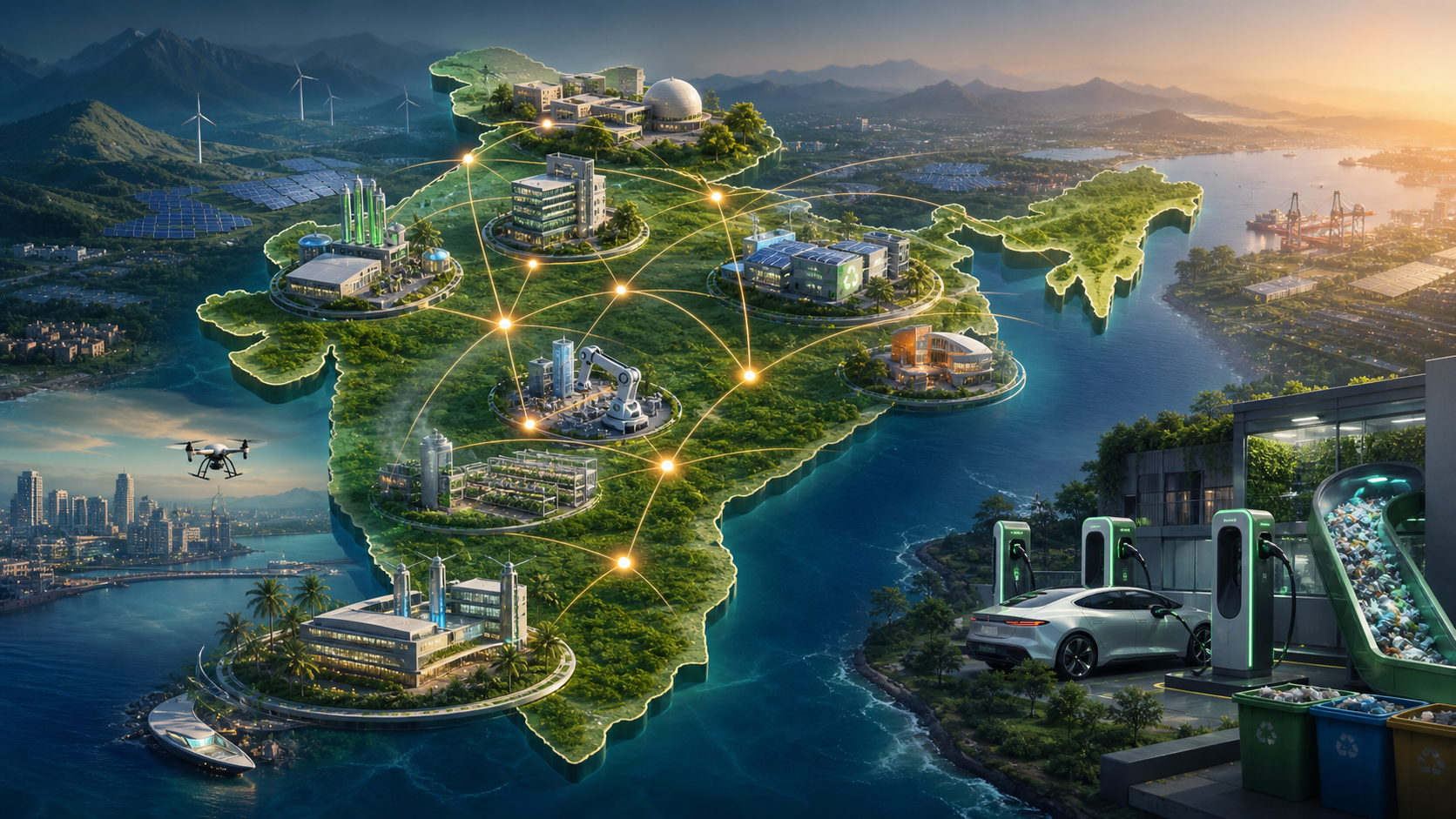
India’s startup ecosystem is becoming geographically broader and more climate-aware. Government data indicate that roughly half of recognised startups now come from Tier-2 and Tier-3 cities, while private-market research shows substantial long-term capital flowing into climate technology.
Those trends create real opportunity, but they should not be mistaken for proof that venture capital has already abandoned Bengaluru, Delhi and Mumbai. Major metros still dominate disclosed funding, senior talent networks and large exits.
The rise of regional innovation
Cities such as Coimbatore, Indore, Kochi, Surat and Bhubaneswar offer specialised industrial clusters, universities, lower operating costs and proximity to problems that are difficult to understand from a metropolitan office.
Agricultural technology, logistics, manufacturing software, mobility, healthcare delivery and local-language services can benefit from founders building close to customers. Remote and hybrid work have also made it easier to recruit selected technical and commercial roles across locations.
Geographic recognition is not the same as venture funding. Many government-recognised startups are bootstrapped or locally financed, and disclosed institutional capital remains concentrated in a smaller number of hubs. A regional company still needs access to customers, specialist employees, follow-on investors and experienced governance.
Climate tech moves toward the industrial core
Tracxn’s India Climate Tech 2026 research estimated approximately $12.8 billion of cumulative funding across 1,583 funded companies, with annual investment rising from about $315 million in 2020 to $2.6 billion in 2025.
The opportunity extends well beyond consumer-facing sustainability apps. EV charging and components, grid software, energy storage, industrial efficiency, water systems, waste processing, circular materials, carbon measurement and climate-resilient agriculture all address physical operating costs or regulatory requirements.
B2B demand can become durable when a product lowers energy use, improves material recovery, meets procurement standards or reduces compliance risk. But corporate sustainability commitments do not automatically create short sales cycles; infrastructure approvals, pilots and project finance can make climate businesses slow and capital-intensive.
Why regional cities can matter
Climate and industrial startups often benefit from proximity to factories, farms, ports, energy assets or municipal systems. A founder in Coimbatore may have better access to engineering supply chains than one in a generic software district; a waste-management company may need city-level operating relationships more than a prestigious postcode.
Regional ecosystems also face constraints: fewer specialist funds, thinner senior hiring markets, limited laboratory infrastructure and more travel for enterprise sales. Incubators, state policy and university networks help, but they do not remove these execution challenges.
The founder’s playbook
The funding market remains selective. A climate label or Tier-2 origin is not an investment thesis by itself.
Founders need to quantify the customer’s economic benefit, demonstrate that unit economics survive deployment and maintenance, and show how capital requirements will be financed. Hardware and infrastructure companies should separate technology risk, manufacturing risk and project-finance risk rather than presenting one blended growth story.
Governance, reliable accounting, intellectual-property ownership and realistic paths to gross margin matter across every city and sector. For regional founders, deliberate networks of customers, advisers and follow-on investors can compensate for a smaller local capital pool.
The next wave
India’s next major startup could emerge from a climate laboratory in Coimbatore, a manufacturing network in Surat or an agritech platform in Indore. It could also emerge from Bengaluru.
The investable insight is not a prediction about the next unicorn’s postcode. It is that startup opportunity is spreading toward real-economy problems, and founders outside the largest metros now have a more credible route to build nationally relevant companies—provided capital, capability and customers grow with them.