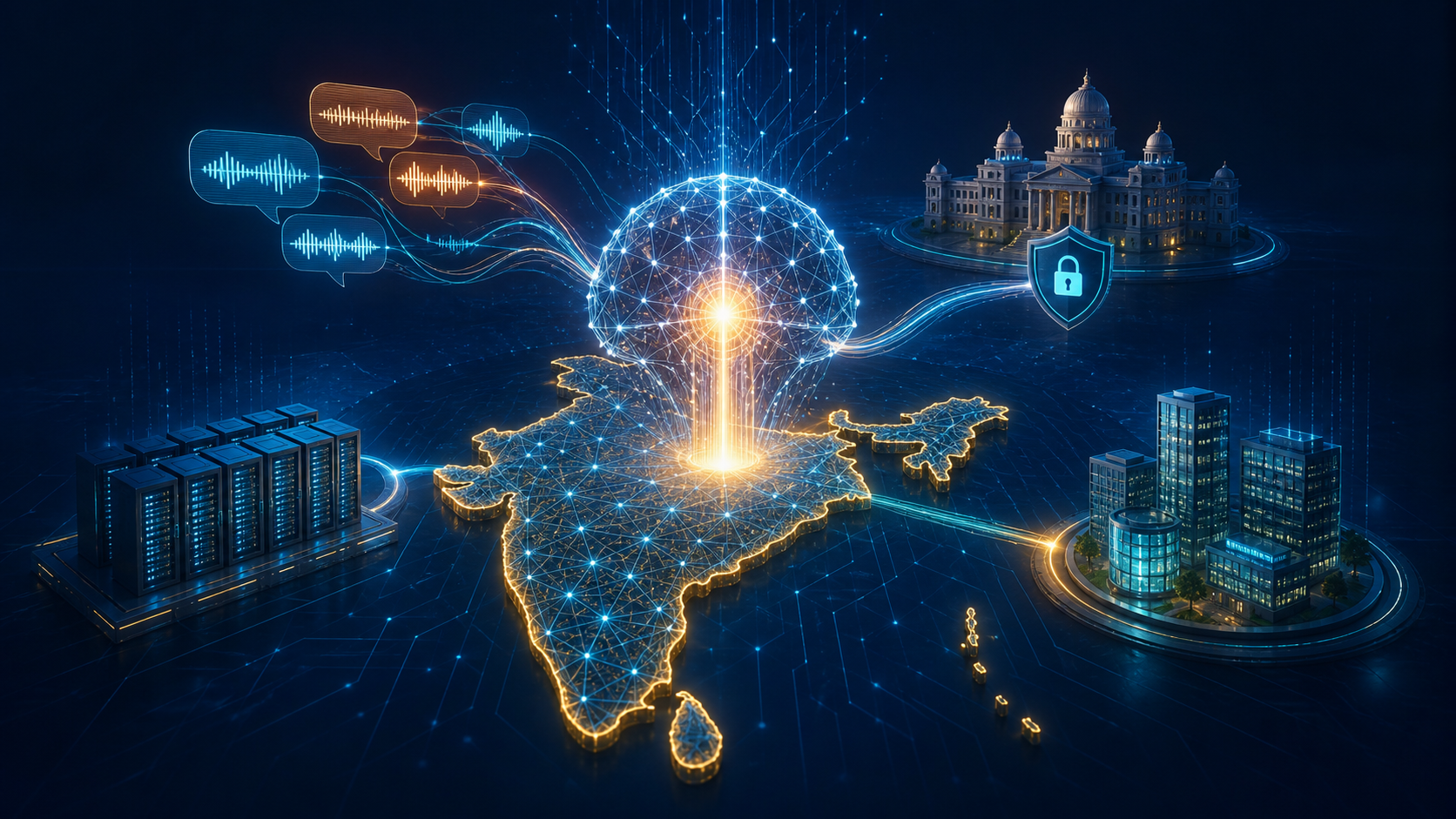
Sarvam has moved into a different tier of India’s artificial-intelligence market. In June 2026, the Bengaluru company announced a $234 million first close of a planned $300 million Series B at a $1.5 billion post-money valuation.
HCLTech committed $150 million as the lead strategic investor. Bessemer Venture Partners also participated, with continued support from Khosla Ventures and Peak XV Partners. The financing makes Sarvam a unicorn by the standard valuation definition, although the announced $234 million was the first close—not the full $300 million target.
Why HCLTech matters
The most important feature of the round may be the investor rather than the valuation. HCLTech brings enterprise relationships, engineering capacity and implementation reach that a young model company would otherwise need years to build.
That creates a potential route from research to contracts: Sarvam supplies models, speech technology and a sovereign deployment stack, while HCLTech can integrate those tools into enterprise and government systems.
Strategic backing also creates execution questions. Investors will want to know whether the partnership produces diversified external revenue, how commercial rights are divided and whether Sarvam can retain product independence while relying on a much larger distribution partner.
The model layer
Sarvam open-sourced Sarvam 30B and Sarvam 105B in March 2026 under the Apache 2.0 licence. Both are reasoning models using mixture-of-experts architectures, which activate only part of the full parameter set for each token to manage compute requirements.
The company says the models were trained from scratch in India using compute supplied through the IndiaAI Mission. Sarvam 30B powers its Samvaad conversational-agent platform, while Sarvam 105B powers Indus, an assistant designed for reasoning and agentic workflows.
Open weights improve inspectability and allow developers to deploy or adapt the models. They do not by themselves establish frontier performance. Independent evaluation across Indian languages, factuality, coding, safety, latency and total serving cost will be essential.
From government pilots to public infrastructure
Sarvam has documented state partnerships and conversational-AI deployments, including work with Maharashtra departments to gather farmer and citizen-service feedback. The available primary records do not substantiate the claim that Indus was deployed to exactly 2,500 Maharashtra officials in August, so that figure should not be treated as established.
Government adoption is also not only a sales milestone. Public-sector AI requires procurement clarity, data-minimisation rules, security testing, audit logs, human review and reliable redress when automated systems fail.
What sovereign AI means
Sovereignty is broader than where a model was trained. It includes control over data, weights, deployment, security and the ability to operate without an external provider withdrawing access.
But no modern AI stack is entirely self-contained. Sarvam still operates within global semiconductor, networking and software ecosystems. Its practical advantage must therefore come from Indian-language performance, local deployment, lower costs and institutional trust—not the sovereign label alone.
The takeaway
Sarvam now has capital, government support, open models and a strategic enterprise channel. That combination makes it one of India’s most consequential AI companies.
The $1.5 billion valuation is a financing marker, not proof that Sarvam has become India’s default AI operating system. The stronger test will be independently measured model quality, repeat enterprise revenue and public deployments that demonstrate both usefulness and accountability at scale.