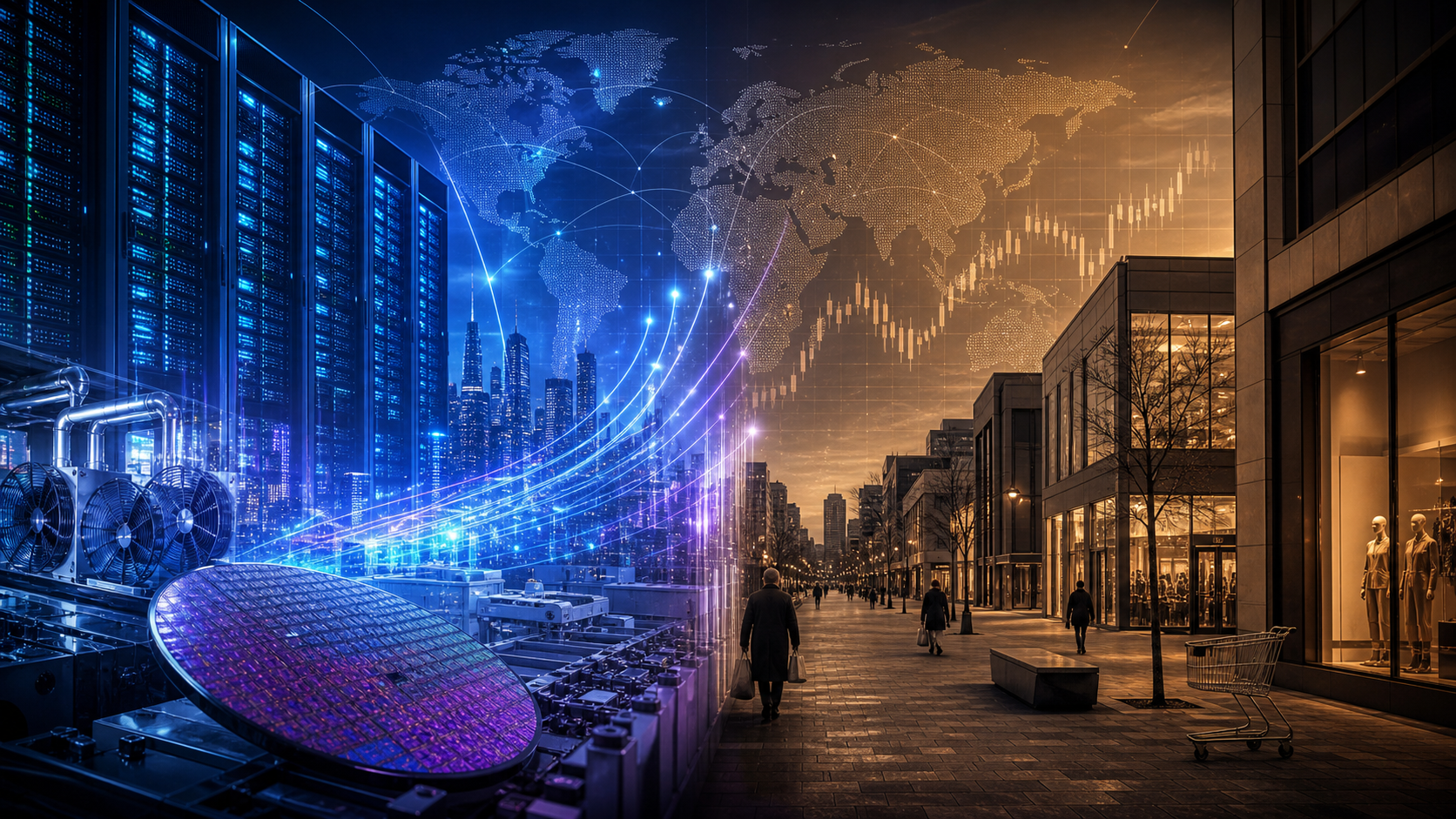
Is the global economy running on two different engines? By August 2026, the contrast between artificial-intelligence infrastructure spending and the rest of the demand cycle had become difficult to ignore.
Amazon, Alphabet, Microsoft and Meta have outlined combined 2026 capital expenditure approaching $700 billion or more, depending on the latest guidance and accounting definitions. Amazon alone has discussed roughly $200 billion, Microsoft about $190 billion, Alphabet around $175–185 billion and Meta at least $130 billion after its latest update.
Much of that money is flowing into data centres, advanced semiconductors, networking, cooling and power. It supports a concentrated ecosystem of cloud platforms, chip designers, foundries, equipment suppliers, utilities and construction companies—and helps explain why AI-linked earnings and investment have carried unusual weight in US equity sentiment.
Concentration without illusion
The S&P 500 is genuinely broad by company count, but it is market-capitalisation weighted. Its largest technology and technology-adjacent companies therefore exert an outsized influence on index returns.
That does not make index stability an illusion: the companies generating those returns are real, highly profitable businesses. It does mean that a diversified-looking portfolio can contain substantial common exposure to the same AI spending cycle, semiconductor supply chain and valuation assumptions.
The consumer picture is regional
US household buffers have weakened. The Bureau of Economic Analysis reported a personal saving rate of 2.7% in June, down from 3.5% in March. Disposable income rose 0.2% during June while personal consumption expenditure increased 0.3%, suggesting that spending continued but left less room for saving.
Europe does not tell exactly the same story. The euro-area household saving rate remained at 14.3% in the first quarter of 2026, while real income and real consumption per person were broadly flat. That points to stagnation and caution rather than a uniformly depleted savings cushion.
Consumers are also divided by income, housing tenure and debt structure. Higher-income households with financial assets can experience the AI-led market boom very differently from renters and borrowers facing expensive credit and cumulative price increases.
Manufacturing is fragmented too
European industry remains soft. Eurostat estimated that euro-area industrial production declined 0.2% in May from April and 1.2% from a year earlier.
Asia, however, is not experiencing one broad manufacturing slump. S&P Global’s mid-year PMI review found strong second-quarter output growth in Japan, South Korea and Taiwan, with mainland China also improving. ASEAN growth, by contrast, came close to stalling after a stronger start to the year.
Some of that strength reflected precautionary inventory building after the Middle East conflict, so it should not automatically be treated as durable final demand. The more accurate description is divergence: East Asian technology and export hubs accelerated while other manufacturing regions struggled.
Can the AI cycle sustain itself?
The spending loop is powerful but not literally self-sustaining. Hyperscalers finance investment with cash generated by cloud, advertising, commerce and software businesses, while some important AI customers themselves depend on continuing external capital.
The cycle ultimately needs revenue and productivity gains sufficient to justify depreciation, energy costs and financing. If utilisation, pricing or customer demand disappoints, today’s capital intensity could become tomorrow’s margin pressure.
The portfolio implication
A broad global index is not simply an unhedged bet on AI. It contains financials, healthcare, industrials, consumer companies and markets outside the United States. Yet US mega-cap companies occupy a large enough share of many global benchmarks that investors should understand the concentration they actually own.
Diversification does not require abandoning the strongest earnings engine in global markets. It means testing how a portfolio would behave if AI capital expenditure slowed, bond yields stayed high or household demand weakened.
Depending on objectives and risk tolerance, that review may include geography, sector, company size, duration, credit quality and income sources. Defensive or yield-producing assets can reduce some equity volatility, but they introduce their own inflation, interest-rate and currency risks.
The central late-2026 question is therefore not whether technology or the consumer will “win.” It is whether the productivity created by unprecedented AI investment can spread through the wider economy before weaker household and industrial demand becomes a more powerful drag.